About the
Book
Synopsis, science and characters.
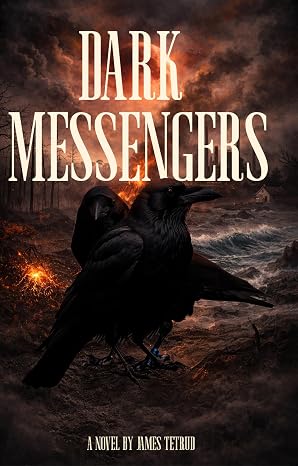
Dark
Messengers
A medical student at Cambridge finds a raven hatchling stunned on the grass outside his dormitory. Told at the pet shop that the bird will have to be put down, he buys a cage instead and takes it home. He names it Edgar, after Poe.
Edgar does not mimic. Edgar talks. He learns phrases, uses them in context, and one evening is found perched on a keyboard, pecking at the keys. Asked what he is doing, the raven answers: “Letter.”
Twenty years later, Nigel Carpenter is a neuroscientist who has never stopped asking what that bird understood. With Mary Taylor, a colleague from MIT, he begins a line of research no ethics committee would approve. They reprogram their own skin cells into stem cells, culture them into brain organoids carrying the speech and auditory regions of their own cortex, and introduce those organoids into raven embryos. Six eggs are selected. Four hatch. Two survive.
Sam and Sally look like any other raven. They are not. They learn English, then history, then the news, and they begin asking the kind of questions their makers cannot answer. Ravens live in the world humans have built. They have seen the flooded coastlines, the burning forests and the sickened flocks, and they arrive at a conclusion the scientists never taught them: the species responsible will not stop on its own.
Elsewhere, refineries are exploding, from Baytown, Texas to the Persian Gulf. In Scotland and the Netherlands, ornithologists are tracking flock behaviour that no model can account for, and one of them isolates a signal at a frequency the human ear cannot detect. And in Silicon Valley, the founder of an artificial intelligence company with a global platform is about to be shown something he will not be able to unsee.
What the scientists intended was a discovery. What they released was a messenger.
Chapter 1
It was late when Jack Johnson completed his rounds at the refinery. His job was to ensure there were no leaks. Job done, he climbed into his jeep, started the engine, and put it in drive. He was about to drive through the north gate when the sky lightened. When he looked around, he saw a bright flame shooting into the sky behind him.
He grabbed his phone, punching in the number for Ben Walker. Ben maintained the fire prevention system; he’d know what to do. Then, he pushed his foot to the floor, racing toward the gate.
Before he could make it to the gate, before the call even connected, there was a BOOM, the world shook, and Jack’s truck bucked, but kept going.
When he looked back, the whole refinery was on fire. Turning back to face front, he instinctively ducked. Above him, hundreds of blackbirds flew.
The Science
None of the science in this book was invented
Every technique that produces Sam and Sally exists today. The novel closes with a terminology guide and nine peer-reviewed references so readers can follow the work themselves.
Stem cells
Early in development, cells have not yet been assigned a purpose. Those are stem cells, and they can renew themselves indefinitely or become tissue-specific cells with specialised function.
Induced pluripotent stem cells
Early in development, cells have not yet been assigned a purpose. Those are stem cells, and they can renew themselves indefinitely or become tissue-specific cells with specialised function.
Organoids and assembloids
Cultured under the right conditions, stem cells self-organise into three-dimensional miniature versions of organs, including the brain. Combine two or more and you have an assembloid, a functioning model of how neural circuits form.
CRISPR- Cas9
A tool for inserting and deleting genes with precision. It carries the promise of cures for Alzheimer’s, Parkinson’s and Huntington’s disease. It also carries the possibility of choosing a child’s height, eye colour, endurance or cognitive ability before birth. In 2018 a Chinese scientist used it to edit a gene in twin infants.
The question Dark Messengers asks is not whether any of this is possible. It is what happens when someone decides to find out.
The Cast
Nigel Carpenter · English neuroscientist at Cambridge University. Found Edgar. Never stopped wondering.
Mary Taylor · Neuroscientist at MIT. The one who hedges her bets, and the one who understands first what they have done.
Edgar · Nigel’s raven. The reason any of this happened.
Sam and Sally · The two surviving hybrids. Part raven, part human, entirely their own.
John Smothers · Ornithologist at St Andrews University, tracking a pattern across continents.
Bastian Brooker · Ornithologist at Radboud University, Nijmegen; hears what nobody else can.
Mike Waters · Founder and CEO of FlowX, an artificial intelligence company with the reach to put a message in front of every person on Earth.
FAQ
What is Dark Messengers about?
Two neuroscientists use induced stem cells, brain organoids and CRISPR-Cas9 to enhance the cognition of ravens. Two of the resulting birds survive, learn to speak and understand, and reach conclusions about humanity that their makers never intended to teach them.
Is the science real?
Yes. Stem cell reprogramming, brain organoids, assembloids and CRISPR-Cas9 gene editing are all in current use. The novel includes a terminology guide and a full reference list of the published research it draws on.
Do I need a science background to enjoy it?
No. The book explains what it needs to as the story moves, and the technical material sits at the back for readers who want to go further.
Why ravens?
Corvids are among the most cognitively sophisticated animals alive. They cache food for the future, recognise individual human faces, deceive one another, use tools and solve problems that defeat a young child. They are also, in almost every mythology on Earth, messengers. The novel starts where the research already is.
What makes this different from other science thrillers?
It was written by a former Professor of Neurology at Stanford whose research career was spent on human cognition and movement disorders. The laboratory scenes read the way they do because the author has worked in one.
Is it suitable for book clubs?
Very much so. Reading group questions are available on request through the contact page.